Thursday, July 29, 2010

UNISON comprehensively rejects the Independent Budget Review proposals

Date: Thursday 29 July 2010


UNISON Scotland today comprehensively rejected the Independent Budget Review proposals as an assault on public services that will damage the economy.

Scottish Organiser Glyn Hawker said:
“This is not an attempt to balance the books. It is a major assault on vital public services and it is about opening up profit opportunities for the fat cats.

“The report hides behind a rhetoric of ‘tough choices’ and ‘targeting’, but what these proposals will do is reduce the quality of life for all but the richest, as the services we use are removed or run down.

“Once the Scottish people realise that this means handing over their water service to the bankers, reducing the quality of their child’s education and cutting back on their elderly relatives’ care, they will reject this agenda.”

As well as up to 60,000 job losses, the report includes a range of proposals that run the risk of putting us back into recession.

Glyn added:
“Job losses on this scale will of course hit services. And their insistence on redundancies and pay freezes run the risk of taking us back into recession. With 70p in every pound spent on public services finding its way back into the local economy the programme of mass redundancies and real terms wage cuts will be a real blow to many local economies across Scotland.”

UNISON, the largest public services union, has said all along that the real issue is the kind of services our society wants and how we pay for them. It is wrong for politicians to be willing to make cuts on such a scale, yet not to consider fair taxation. The Scottish Parliament has tax varying powers and the people of Scotland voted for it to have them.

The report suggests the council tax freeze is unsustainable and that is correct, but UNISON would also say it is unsustainable not to look at asking those who can pay more in tax to do so.

Glyn said:
“Cuts on this scale will hit middle and low income families hard and will be especially hard on women. If classroom assistants lose their jobs, mums will be expected to volunteer. They also face cuts in before and after school services that could affect whether they can work.”


UNISON response to the Report’s chapter conclusions and recommendations:

Public Spending Environment
UNISON believes all public services are valuable, and should be ring fenced. Why should the ordinary people of Scotland pay for the bankers’ greed? Let us be clear though - the Independent Budget Review argues for a policy of no protected areas in public sector: this means health and education will face cuts along with the rest of our public services.

Fair taxes and government borrowing remain the most cost-effective ways of funding public spending.


Efficiency
The Review accepts that efficiencies will become ever more "challenging" - and then sets a minimum 2% annual efficiency target. The real agenda however is revealed in the well worn recommendations for shared services arrangements across the public sector; and "mainstream roles" for the private and voluntary/third sectors in the delivery of public services. These are not plans for efficient and effective public services - they are in fact costly and inefficient ways of opening up public services to profiteers.


Remuneration and workforce
The loss of up to 60,000 jobs will have a major impact on services. The proper place to deal with public sector pay is in negotiations. Pay freezes and pay cuts for public service workers will damage economic recovery, and hit local communities and small businesses too. UNISON will continue to campaign for fair pay as inflation rises around 5%.

Flexibility would open up issues of equal pay which we are only now resolving after 40 years of the Equal Pay Act.


Universal services
Introducing charges and means testing to services that currently benefit everyone creates an expensive new bureaucracy. If there is a concern that some people are receiving services they can well afford, the value for money option is to charge them via taxation rather than setting up a ‘department for social insecurity’ to administer charging.


Capital
Scottish Water should remain in democratic control. Setting it up as a ‘public interest company’ would be privatisation by stealth.

An enhanced role for the Scottish Futures Trust is likely to see further wasteful use of private financing for public sector projects. Lessons must be learned from the hugely expensive PFI/PPP projects.


Shaping the future
Scotland’s Parliament should provide leadership by working to fund quality public services and resisting a cuts and privatisation agenda.


ends


Notes to Editors:

1. UNISON responses to the report, including two earlier releases today, are here on our frequently updated blog at: http://unison-scotland.blogspot.com/

2. UNISON’s alternative budget is at: www.unison.org.uk/acrobat/18887.pdf

3. UNISON’s submission to the Independent Budget Review is at: http://www.unison-scotland.org.uk/response/UNISONResponse_IndependentBudgetReviewApril2010.pdf


For Further Information Please Contact:
Glyn Hawker, Scottish Organiser (Bargaining & Equal Pay) 07876 441 237
Fiona Montgomery, Communications Officer 0141 342 2877 (o) 07908 672 890 (m)
Malcolm Burns, Communications Officer 0141 342 2877 (o) 07958 063 182 (m)



'Not in the public interest': UNISON calls on government to reject privatisation of Scottish Water by stealth

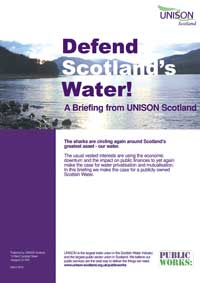
Defend Scotland's Water: briefing
on the case for public ownership.
Click here for pdf
Date: Thu 29 July 2010

UNISON has called on the Scottish Government to reject the proposal to effectively privatise Scottish Water contained in the Independent Budget Review.

Gerry Crawley, Regional Organiser, said:
"The proposal to privatise Scottish Water by stealth is not acceptable - and is certainly not in the public interest. We call on the Scottish Government to reject this unwise proposal.

"The pro-privatisation sharks have been circling around Scottish Water, first proposing a different funding mechanism, then a supposedly mutual model. The latest disguise is what they call a 'public interest company' similar to Welsh Water. These are all attempts to privatise by stealth.

Gerry Crawley said:
"We certainly do not want follow the Welsh Water model as a mutual or 'public interest company'. In the capital intensive water industry, bodies like these are effectively controlled by the private financial institutions. They would insist that their risk is minimised by transferring services and jobs to English and European private water companies. That is what is happening at Welsh Water."

"Any move away from democratic control and towards private funding - including under the guise of a 'public interest company' - would actually cost us all more. The people of Scotland do not want to see profiteering from such an essential public service. It is simply not in the public interest."

Gerry Crawley said:
“Scottish Water belongs to the people. It is owned by the Scottish government for the Scottish people. This issue has already been settled by a referendum. UNISON is 100% certain that the Scottish people will reject any attempt to remove Scottish Water from democratic control."


ends


Note for Editors:

1. UNISON’s recent briefing Defend Scotland’s Water has highlighted how the pro-privatisation sharks are circling around Scottish Water; why these vested interests want it sold off at a knock-down price; and how private finance would lead to private control. Defend Scotland’s Water is available on the UNISONScotland website at http://www.unison-scotland.org.uk/water/defendscotlandswater_mar2010.pdf

2. UNISON, along with the STUC and the other unions involved in the water industry all believe that we should join with the worldwide movement in favour of democratisation of water. The unions have produced a discussion paper It’s Scotland’s Water outlining ways to greater accountability for Scottish Water. It is available on the UNISON website at http://www.unison-scotland.org.uk/water/scotland's_water.pdf


For Further Information Please Contact:
Gerry Crawley, Regional Organiser 07958 121 805 (m)
Fiona Montgomery, Communications Officer 0141 342 2877 (o) 07908 672 890 (m)
Malcolm Burns, Communications Officer 0141 342 2877 (o) 07958 063 182 (m)


.

UNISON rejects unwise prescription for assault on public services – initial response to IBR

Date: Thursday 29 July


UNISON today rejected the prescription of the Independent Budget Review for an assault on Scotland’s public services and privatising Scottish Water.

Scottish Organiser Glyn Hawker said that the report trots out the same tired old dogma that ordinary people need to pay the price for a financial crisis they did not create.

Glyn added: “Crawford Beveridge said in March that we faced Sophie’s Choice and there is no way to implement these cuts without causing great pain. These proposals are unwise, will cause great pain and we think the people of Scotland will reject this approach.

“UNISON Scotland believes there is an alternative that politicians should be fighting for – an alternative that looks at what public services the Scottish people want in a decent society.

“We can afford quality services. We should not be hitting ordinary people with cuts to services they rely on, with cuts to pay and jobs and family income when bankers still pick up huge bonuses and don’t pay their fair share towards services we all rely on.

“These proposals will create a more unequal society. Crawford Beveridge said there are no silver bullets and the report says that we need to do more with less but we can’t. It will be less with less. And the end result is that the rich will be able to pay for services but middle and low income families will be hardest hit.”


Notes to Editors:

1. Glyn Hawker and other UNISON representatives are available for comment and reaction to the Independent Budget Review report.

2. A detailed response to the report will be issued later this afternoon.

3. UNISON responses to the report will be posted on our frequently updated blog here at: http://unison-scotland.blogspot.com/

4. UNISON’s alternative budget is at: www.unison.org.uk/acrobat/18887.pdf

5. UNISON’s submission to the Independent Budget Review is at: http://www.unison-scotland.org.uk/response/UNISONResponse_IndependentBudgetReviewApril2010.pdf

6. Our news release ‘Removal of Scottish Water from democratic control would be unwise’ is at: www.unison-scotland.org.uk/news/2010/julyaug/2307a.htm


For Further Information Please Contact:
Glyn Hawker, Scottish Organiser (Bargaining & Equal Pay) 07876 441 237
Fiona Montgomery, Communications Officer 0141 342 2877 (o) 07908 672 890 (m)
Malcolm Burns, Communications Officer 0141 342 2877 (o) 07958 063 182 (m)


.

Glyn Hawker on BBC: There is an alternative. We don't need to be making these cuts.

July 29

UNISON Scottish Organiser Glyn Hawker today argued on BBC Radio Scotland's Good Morning Scotland programme that there is an alternative to the current cuts and privatisation agenda.

Speaking in advance of today's Independend Budget Review report, she said: "There is an alternative. We don't need to be making these cuts.

"The alternatives are about generating income, about making sure we collect the tax currently not being collected, that we look at those people who do have more making a bigger contribution rather than taking away from those at the bottom end."

The so-called Tax Payers Alliance were also interviewed. UNISON has highlighted the fact that the TPA is an unrepresentative right wing body keen to promote massive cuts in public sector spending. UNISON is a democratic organisation made up of tax payers and could make far more claim to the name. The TPA is made up of right wing ideologues and non-dom millionaires.

For some interesting facts about the TPA, check out the website of The Other Taxpayers Alliance.  www.taxpayersalliance.org/

Listen to Good Morning Scotland here The interview starts at about 1 hour 9 mins into the recording.


.

Mike Kirby on Newsnight Scotland: Ring fence all public services


UNISON's Scottish Convener Mike Kirby was interviewed on the BBC's Newsnight Scotland in advance of publication of the Independent Budget Review report today.

He argued that the debate should not be about cuts or which services to ring fence, but about the kind of public services Scotland wants.

He added: "All public services should be ring fenced."

Watch the programme here

.

Wednesday, July 28, 2010

‘Three wise men’ – UNISON warns cuts and privatisation will damage the economy


Date: Wednesday 28 July 2010

UNISON today warned that tomorrow’s Independent Budget Review report is set to respond to a cuts and privatisation agenda rather than looking at what services Scotland needs and can afford.
Scottish Organiser Glyn Hawker said that the real issue is what kind of society we want - not cuts and privatisation that will damage the economy, axe thousands of jobs and cause misery for countless families.

UNISON believes that there is a realistic alternative to the predicted massive cuts in public spending which risk a double dip recession.

Glyn Hawker said:
“The real issues are what kind of services our society wants and how we pay for them. But the remit for the so-called three wise men does not allow them to look at any UK level questions of economic policy, public spending, taxation or national debt.

“This means that they are the ‘fall guys’ to provide cover for politicians to make extremely unwise cuts at a time when public spending is crucial to economic recovery.

“The current financial crisis, which was not caused by nurses or school janitors or social workers, is being used by those who want to attack the public sector.

“UNISON believes that Scotland can continue to afford to provide excellent services, delivered in the public sector. We need to look at clamping down on tax avoidance, raising taxes for those who can afford to pay more, and cutting out wasteful spending including Trident and expensive PPP/PFI projects.”

ends

Notes to Editors:

1. Glyn Hawker and other UNISON representatives will be available on Thursday for comment and reaction to the Independent Budget Review report.

2. UNISON responses to the report will be posted on our frequently updated blog at: http://unison-scotland.blogspot.com/

3. UNISON’s alternative budget for UK (July 2010) is at: www.unison.org.uk/acrobat/18887.pdf

4. UNISON Scotland submission to the Independent Budget Review (April 2010) is at: www.unison-scotland.org.uk/response/ UNISONResponse_IndependentBudgetReviewApril2010.pdf

5. Our news release ‘Removal of Scottish Water from democratic control would be unwise’ (23 July 2010) is at: www.unison-scotland.org.uk/news/2010/julyaug/2307a.htm


. 

Mike Kirby - response to pro-cuts attack on public service unions in Herald

Public sector pay and productivity easily stand comparison with private firms
Published on 28 Jul 2010 in The Herald Letters

Andrew McKie appears to argue that because some workers in public services have a vote in the Labour leadership, they should face redundancy and wage cuts (“Public sector unions need to bite the bullet and accept cuts”, The Herald, July 26 ). He is surely entitled to this bizarre opinion but it’s one I’m sure few Herald readers will share. More serious is the way he repeats distorted figures about pay and productivity in public services (courtesy of the right-wing campaign group Policy Exchange).

He tells us that public sector workers are paid 30% more per hour than those in the private sector. This raw figure is meaningless because like is not compared with like. The Office for National Statistics Labourforce Survey lists 8.6% of private employees as professionals, whereas these form 24.5% of public employees. Incidentally, including the employees of nationalised banks in the public sector earnings figures is a good way of inflating them, but not really representative.

The only meaningful comparison between public and private is to look at similar levels of qualification. This shows graduates in public services are paid 3.4% less than those in the private sector. Those with higher education qualifications short of a degree are paid 6.2% less, and those with school level qualifications are paid the same.

Andrew McKie tells us that public sector productivity has fallen. The Office of National Statistics says productivity has shown positive growth since 2006. Productivity did fall in the early years of the decade, but this was to be expected as there is an inevitable lag between upfront investment and improved output and outcomes. That rates of productivity improvement are faster in the private sector is also to be expected. The private sector includes manufacturing, where technology can replace workers. Public services are inherently labour-intensive. These are factors which are well understood by economists, but not it seems by ideologues.

Part of Andrew McKie’s justification for an attack on workers who provide public services (and it’s typical that he shows no sign of having thought about what the impact will be on those services) is that so much pain has been endured by the private sector. Really? A report by Incomes Data Services says bonus levels in FTSE-100 boardrooms have increased by an average of 22.5% over the past six months to just shy of £559,000. Salaries have risen by 7% from last year.

It’s also not just the big companies who are cashing in. According to the survey, which looked at 237 directors in 180 listed companies, bosses of FTSE 250 companies have seen their total incomes (salary and bonuses) rise by 8%, and Small Cap directors’ pay went up by 5.3%. No-one in the public services is contemplating those sorts of pay rises.

Andrew McKie in his bid to paint the Labour Party as a wholly-owned subsidiary of unions representing workers in public services wildly overstates our influence. To take just one example – were ours the decisive influence, Labour would have long since abandoned the wasteful folly of PFI. Contrary to Andrew McKie’s “whip hand” fantasies, our priorities remain, as always, the protection of public services and those who work in them.

Mike Kirby,
Convener, Unison Scotland,
14 West Campbell Street, Glasgow.